Nanchang

Nanchang is the capital of Jiangxi Province, China, located in the north-central part of the province on the Poyang Lake Plain.
- Country
- China
- Province
- Jiangxi
- Area type
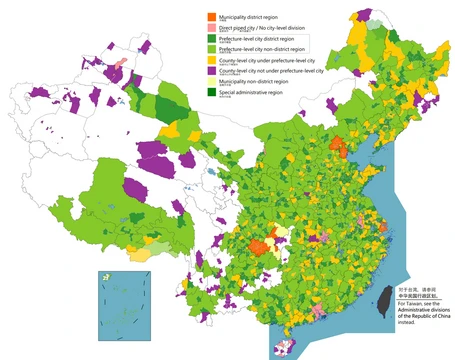
- Prefecture-level city
- Major industry
- Aircraft and automobile manufacturing, textiles, chemicals
- Climate
- Humid subtropical (Köppen Cfa)
Lore & Background
The territories encompassing modern-day Jiangxi were first incorporated into China during the Qin dynasty. In 201 BC, during the Han dynasty, the city was named Nanchang and became the administrative seat of Yuzhang Commandery, whose construction was overseen by General Guan Ying. The name Nanchang means 'southern flourishing,' a name that originated in the Han dynasty, though the specific motto attributed to Emperor Gaozu is not verified by standard historical sources. During the Yuan dynasty, Nanchang was the capital of Jiangxi Province, which at that time included much of modern-day Guangdong. At the end of the Yuan period, it became a battleground between Zhu Yuanzhang, founder of the Ming dynasty, and the rival warlord Chen Youliang. In the early 16th century, it was the power base from which Zhu Chenhao, the Prince of Ning, launched a rebellion. During the Ming dynasty, it housed exiled relatives of the emperor, though the claim that the imperial family constituted about one quarter of the city's population is not supported by reliable census or historical records; Matteo Ricci came here when trying to gain entry to Beijing. In the 1850s, Nanchang suffered considerably from the Taiping Rebellion, and its commercial importance declined as overland routes to Canton were replaced by coastal steamship services. The uprising held the city for only a few days but provided a core of troops and organizational method for the later People's Liberation Army. Since 1949, Nanchang has been extensively industrialized, becoming a producer of
Reader's Guide
This has given the city a symbolic status as 'the place where the military banner of the People's Liberation Army was first raised.' The city's strategic location connecting prosperous East and South China has made it a major railway hub in recent decades. Economically, Nanchang has transformed from an old-style administrative and commercial city with little industry in 1949 into a large-scale producer of textiles, paper, food products, and heavy industrial goods including trucks, tractors, and aircraft. It is also a regional hub for agricultural production, with rice and oranges as economic staples.
Did You Know?
- The name Nanchang means 'southern flourishing,' a name that originated in the Han dynasty, though the specific motto attributed to Emperor Gaozu is not verified by standard historical sources.
- During the Ming dynasty, exiled imperial relatives lived in Nanchang, but the claim that they made up about one quarter of the population is not supported by reliable records.
Imperial Roots and Provincial Rise
Nanchang's story as a Chinese city stretches back to the Qin dynasty, when the region was wrested from the Baiyue peoples and organized as Jiujiang Commandery. The name Nanchang arrived in 201 BC under the Han, when Emperor Gaozu's general Guan Ying was appointed to govern the newly designated Yuzhang Commandery. The name means "southern flourishing," a phrase traditionally linked to Gaozu's vision for developing the south. Over the centuries the city's administrative rank kept climbing: it became the prefecture of Hongzhou in 589, then the provincial center of Jiangxi after 763. By the 12th century, Jiangxi had grown into the most populous province in all of China. Nanchang also served as the southern capital under the Southern Tang in 959 and later as the capital of a Yuan-dynasty Jiangxi province that encompassed even Guangdong. The city's imperial-era significance was not purely administrative; it was also a stage for conflict, as Zhu Yuanzhang clashed with the warlord Chen Youliang in the late 1300s, and as the Prince of Ning staged a rebellion from Nanchang in the early 1500s.
The Uprising and a City's Military Identity
On the night of August 1, 1927, pro-communist Kuomintang officers operating under Soviet direction launched an insurrection in Nanchang that held the city for only a matter of days. Yet the episode proved far more consequential than its brief duration suggested. The Communist Party came to recognize it as the moment the first gunshot was fired against the Nationalists, and the troops and organizational methods that emerged from those chaotic days became the seed from which the People's Liberation Army would later grow. Since 1949, the city has carried the official designation of the birthplace of the PLA and the place where the army's military banner was first raised. This identity has shaped Nanchang's civic narrative in ways few other Chinese cities can match. The city's wartime role did not end with the Uprising: in 1939, during the Second Sino-Japanese War, the Battle of Nanchang saw the National Revolutionary Army clash with Imperial Japanese forces, resulting in more than 80,000 Chinese casualties and over 20,000 Japanese losses. The city's strategic position along the Nanchang-Jiujiang railway, secured after the Battle of Wuhan, made it a critical node in the defense of central China.
Industrial Metamorphosis and the Railway Hub
When the People's Republic was established in 1949, Nanchang was still largely an old-style administrative and commercial town, home to roughly 275,000 people with almost no heavy industry beyond food processing. Its first rail link had only been completed in 1915, connecting the city to the Yangtze port of Jiujiang. The decades that followed transformed the city almost beyond recognition. Cotton textiles and yarn production expanded into a large-scale industry, joined by paper making, rice milling, and a growing chemical sector producing agricultural chemicals, insecticides, and pharmaceuticals. Heavy industry arrived in the mid-1950s with a coal-fired thermal power plant fed by rail shipments from Fengcheng, an iron-smelting plant, and a machinery sector initially focused on agricultural equipment and diesel engines. Nanchang also became a minor but notable center of China's automotive industry, manufacturing trucks, tractors, and tires. Additional rail lines, including a post-war route to Linchuan and Gongqi in the Ru River Valley, wove the city into a broader network. Today, its position linking the prosperous eastern and southern regions has cemented its role as a major railway hub in the south.
Literary Legacy and Cultural Crossroads
Few Chinese cities can claim a literary monument as enduring as Nanchang's Tengwang Pavilion. Built in 653, the structure became immortal in 675 when the young writer Wang Bo composed the Tengwang Ge Xu, a poetic preface so celebrated that it has kept the pavilion, the city, and its author in the consciousness of literate Chinese speakers for over thirteen centuries. The building itself has been destroyed and rebuilt repeatedly; the current structure dates from a 1980s reconstruction after the original was lost in 1929 during the Chinese Civil War. Nanchang's cultural story also reflects its role as a crossroads. During the Yuan dynasty, the city may have served as a center of porcelain trade, and in the Ming era it housed a large population of exiled imperial relatives—roughly a quarter of the city's inhabitants—whose presence drew the Jesuit missionary Matteo Ricci to Nanchang as he sought a route to Beijing. The 1850s Taiping Rebellion dealt a severe blow to the city, and the later shift from overland trade routes to coastal steamship services in the nineteenth century further altered its commercial character, even as Nanchang retained its status as the undisputed regional metropolis of Jiangxi.
Frequently Asked Questions
Why is the 1927 Nanchang Uprising famous?
The Communist Party credits the Nanchang Uprising with firing the first shot against the Nationalist government, making it the symbolic founding moment of the People's Liberation Army. It remains the city's single most cited historical landmark.
What transportation role does Nanchang play?
Nanchang functions as a major railway hub in Southern China, linking several regional and national rail corridors. Its flat position on the Poyang Lake Plain makes it a natural transit node in the central-southern network.
How does Nanchang rank among Chinese cities?
As the provincial capital of Jiangxi, it serves as the administrative and economic center for the entire province. Its combination of strategic rail access, industrial capacity, and research output places it firmly among China's mid-tier national hubs.
More in Cities Of China 1-18
Spotted an error? Know more?
This is a living reference — every entry is fact-audited, and reader corrections feed straight into our audit queue. Suggest an edit · See this site's audit record